Sunday, October 16, 2016

Steamboat School

Based in Missouri in 1847, this realistic fiction story retells the true story of Reverend John Meachum and his "steamboat school." Originally, Reverend Meachum was secretly teaching young African American children underneath a church. When a new law forbidding education for African Americans is enacted, their school is shut down and the children are left without an education. Reverend Meachum, however, did not want to give up on his students. He built a new, floating school inside a steamboat. The steamboat was anchored in the Mississippi River, which was outside of Missouri's jurisdiction, and therefore, legal. 

I thought this story was uplifting and really inspiring, as it followed the true story of a person who would not allow the color of someone's skin dictate their right to an education. The Reverend was an accomplished man that managed to save up enough money to purchase his own freedom, along with his family and his wife's. This book shows his courage and determination and how it helped him accomplish so many selfless things. 

The lessons in this book are brought to life with the illustrations by Ron Husband. They were made by first creating sketches of the scene and then using mechanical pen in an ink to add detail and texture to the drawings. Afterwards, they were finished in Photoshop. The lack of color in the pictures really adds another dimension to the story by suggesting a dark time. 

Overall, this book is a really beautiful depiction of a sad time. Deep feelings are brought to life and I feel as though the ideas that are covered would really resonate with children when presented in this way. Broaching subjects such as slavery and civil rights, it is a great book to delve into "tough" topics with. 

Steamboat School 
By: Deborah Hopkinson 
Illustrated by: Ron Husband 

Published in 2016 

King for a Day

King for a Day is a story written by Rukhsana Khan, a Pakistani female. She tells the story of Basant from the perspective of Malik, a young boy. Basant is a kite festival that celebrates the arrival of spring. With feasts and music, the entire city makes their way to rooftops to take part in the kite flying festivities. This year, Malik has build a special kite, the Falcon, which has been built for speed and agility. Although many other kids will have several kites to battle with, Malik put his faith in God that he would only need one. 

The bully next door is battling his kites, too. In two incredible battles, Malik manages to take down his kites and gets back at him for calling his sister a mean word. By the end of the day, Malik has batted many others and has won, earning the title of "King for a Day!" His brothers and sisters help him capture all of the broken kites and they sort through them after the festivities. As Malik looks over the city after the festival, he sees a girl in the alley below being bullied by the boy next door. He steals her kite and she is left crying. In a sudden act of generosity, Malik anonymously throws a kite down to the girl and he watches her happily walk away. 

I really enjoyed this book, particularly because I do not know very much about Pakistani culture and it has always interested me. I thought that Malik was a noble character that proved his determination payed off. Although the story only portrayed this in the illustrations, Malik was in a wheelchair. His personality and spirit were very present throughout the book and were not overshadowed by the fact that he was disabled. I though that this was a great detail that would help connect students to this piece of literature. 

Another aspect of this book that I really enjoyed were the illustrations. They are an incredible mix of paper and textiles from Pakistan. The colors are vibrant and capture the colors and textures from the region and show the reader what a celebratory time Basant is. The unique and careful layers of materials also gives the reader insight into the character's culture. 

As a whole, I think that the words and the pictures work really well together in this book. They give the reader a sense of who Malik is and his cultural background. I enjoyed getting to learn about Basant wish that I could experience it myself. 

King for a Day 
By: Rukhsana Khan
Illustrated by: Christiane Krömer
Published in 2013

Saturday, October 15, 2016

Desmond and the Very Mean Word

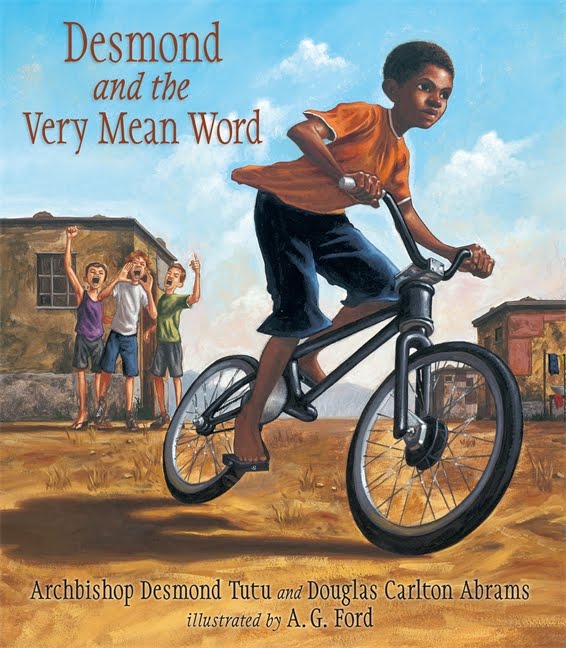
Based on a true story, Desmond and the Very Mean Word is a story about Archbishop Desmond Tutu's childhood in South Africa. In the story, Desmond gets a brand new bicycle and is excited to ride it all around—he can't wait to show his priest, Father Trevor. On the way, however, Desmond encounters some white boys that call him a very mean word. He is angry and wants to get revenge. To do so, Desmond retaliates with another mean word and he instantly regrets it. He turns to Father Trevor for advice, and learns to forgive others even when they haven't said they're sorry yet. So Desmond finds the courage to apologize for his actions and is proud of himself. 

I particularly liked this story because it was written by Archbishop Desmond Tutu, who is a South African social rights activist. It is primarily a story of forgiveness, but it covers so many other topics that are truly important for children to read. Religious undertones aside, Desmond as a character turned to a trusted adult for advice in a tough situation. This is something that all children need to understand how to do. 

I also think that it is a great book to have in a children's library because it shows that a person of great stature dealt with issues growing up—everyone does! Young Desmond is relatable and I think that his experience is generalized enough that any student could identify with what he is going through. The vivid oil painting illustrations bring great emotion to the character's faces, amplifying the story even more. 

Overall, I think that Desmond and the Very Mean Word is one of the many books about forgiveness that children would really enjoy reading. 

Desmond and the Very Mean Word 
By: Archbishop Desmond Tutu and Douglas Carlton Abrams 

Illustrated by: A. G. Ford 
Published in 2013

Blue

Blue is an incredible historical fiction novel about a thirteen year old girl, Ann Fay. Her father goes off to fight in World War II and leaves her his overalls—a symbol that she's stepped into the role of "man of the house." With the help of her family and neighbors, Ann Fay keeps up the garden and works hard to care for her family. When a polio outbreak hits the town and and her family is directly affected, Ann Fay has to find courage within herself to overcome the obstacles she faces. 

I chose to read this book for our "Choice Week" because I have always been interested in World War II. It has been a topic that I've always read about and I enjoy reading historical fiction novels about it. I always wondered what it felt like to live through that period of historical tragedy. Blue gave a very realistic perspective of this for me. I was in awe of Ann Fay's bravery, despite how many unfortunate things she had to deal with at such a young age. Her voice and her internal monologue was encouraging and refreshing, as she continuously chose to do what she knew would be difficult for her.

I think that Ann Fay serves as a model character for many children. She comes down with Polio herself and throughout the entirety of her stay at the hospital, encourages herself to get better and improve. She makes friends with a black girl at the hospital—something uncommon in the 1940s—and fights to spend time with her against the nurse's wishes. Ann Fay models resilience and determination that anyone would want to aspire to have. 

In terms of my future classroom, I think that this would be a great book for upper elementary students learning about World War II or segregation. Additionally, I could use this book to talk about diseases and health around the world.

Blue
By: Joyce Moyer Hostetter  
Published in 2010

Tuesday, October 4, 2016

Why Do Ice Cubes Float?

This book was a really great introductory book for students that may have a lot of questions about scientific concepts, students that are particularly interested in science, or students that may be searching for a topic to complete a project on. The book is a collection of a wide variety of scientific questions, ranging from "How can you get words into candy?" and "Why do some balloons float but others don't?" Each section of the book deals with a different topic and features four to five questions and short answers. 

In my opinion, this is a great "starter" book for students. Because it doesn't have a lot of content and jumps from subject to subject, it isn't necessarily a informational text that I would recommend to someone that needs something informational to read. Instead, I think that it is a great book for a "science sampling." Students can look through the book to get ideas for research or come up with question that they may want answered. They can't however, use this book for research as the answers are relatively short and are not extensive. 

I do see myself using this in my classroom, however. While it may not be an informational text that is full of information, there are many non-fiction text features that are incorporated throughout the book. I think that this is a simple enough text that would work really well for modeling if we are working on non-fiction writing and including text features to increase reader feasibility. 

Why Do Ice Cubes Float? 
By: Thomas Canavan 
Published in 2014 

Eat Your Science Homework

This fantastic non-fiction resource is such a fun way to integrate science and cooking! The book has recipes such as "Atomic Popcorn Balls" and "Sedimentary Pizza Lasagna" that model scientific concepts with a fun activity. Each recipe takes students through a science concept, including pertinent vocabulary. The concept is thoroughly introduced in kid-friendly language and equipment and ingredients are identified. Using the scientific method, children follow the instructions to create their own models of scientific concepts.

I have always been a fan of cooking, so I really enjoyed this book because of its clever structure and the way in which information was presented. Being able to learn about science while doing something that I found incredibly entertaining would be an ideal situation for me as a child! I think that this is a great book for any upper-elementary child, though, because of the variety it has and how engaging it is. Even if you don't conduct the experiments or follow through on the recipes, the book is still fun to read!

The informational text features included in this book are particularly helpful, as they provide the reader with a lot of information that would otherwise be difficult to point out. By bolding important vocabulary, including a glossary of those terms, and having several captions or informative boxes of information throughout the book made staying engaged throughout the entire book really easy.

This would be a great resource at home or at school, as many of the experiments included would be great modeling tools during an science lesson! As part of the author's series, there is another book named Eat Your Math Homework that I'd love to check out to see how they approach the subject of math differently.

Eat Your Science Homework
By: Ann McCallum
Illustrated by: Leeza Hernandez
Published in 2014


Buried Sunlight

The fourth book in the award-winning Sunlight Series, Buried Sunlight is a great upper-elementary book about fossil fuels and their influence on the Earth. In this book, the MIT professor Penny Chisholm creatively explains how coal, oil, and gas are essentially "buried sunlight."

Told from the perspective of the sun, this book really engages readers through its beautiful illustrations that make it very easy for students to understand. The vibrant pictures draw the reader in and double as informational text features, an essential component to informational texts. Included are diagrams with labels on them and timelines that give readers an idea of the amount of time that fossil fuels have been buried underground. Many important vocabulary words are also bolded and typed in all capital letters to draw focus to them.

An aspect of this book that I really enjoyed was the fact that the author included interactive questions that prompted students to stop and think. The author particularly focused on how the earth will continue to change if we continue to engage in the activities that may be detrimental to the earth.

Not only is this a great informational text, but I really enjoyed this book for its incredible illustrations that really made me want to continue reading. I think that students would get a clear idea of fossil fuels and their influence, but the language is relatively advanced. Even adults would benefit from reading this!

Buried Sunlight
By: Molly Bang and Penny Chisholm
Published in 2014