Like Pickle Juice On a Cookie is a novel written in verse that follows the story of Eleanor, eight-year old. Eleanor finds out that her beloved babysitter, Bibi, will be moving away to care for her sick father. Upset and distraught, she has to bear the summer without Bibi and with a new babysitter. Natalie is her newest babysitter, who tries hard to establish a relationship with Eleanor.
Although Eleanor is resistant to Natalie at first, she realizes that she means well and they have fun together. Eleanor decides to write a letter to Bibi to tell her how much she misses her and Natalie waits with Eleanor every day for the mail to check if Bibi has written back. Although it takes her a long time—Eleanor finishes the summer and starts 3rd grade before the letter comes—Bibi finally responds and Eleanor knows that she will be with her forever.
Admittedly, I had never read a novel written in verse before. It had a very lyrical style and was repetitive in nature throughout the book. I thought that the sing-song style of the book was interesting and it captured my attention, but I thought it was rather boring at times. The writing was simple and not necessarily interesting.
I did, however, enjoy the topic that the author chose. It was inspired by an event in the author's life, but it is a situation that almost all children deal with or can relate to. Whether it is a babysitter or a member of the family or a friend, children lose people in their lives and it is important to talk through those feelings of loss and loneliness. This book did that in a way that was approachable and relatable, while being positive about the unwanted outcome.
This book would be a great choice for a child that is going through a big change at home or experiencing some sort of shift in their life. I think that it would help them sort through some of the issues that they face, and would be a great way to discuss feelings when children do not have the words for them.
Like Pickle Juice On a Cookie
By: Julie Sternberg
Illustrated by: Matthew Cordell
Published in 2011
Tuesday, November 8, 2016
Six Dots: A story of Young Louis Braille
Six Dots tells the story of Louis Braille, the inventor of the Braille Alphabet. As a young child, Louis loved to watch his father work in his shop. Although he was too small to help out, he would hang around his father and admire his work. His father would always remind him not to touch anything, especially because he was too young. This bothered Louis and he set out to prove his worth to his father. Unfortunately, this led to an accident that caused loss of sight in Louis' eyes at the age of five.
Louis was a clever boy, however, and he was determined to live just like any other child in spite of his blindness. What he wanted most was the ability to participate in school like all the children around him; he wanted to read and write. He found that there were no books for the blind in his small community, so he traveled to the school for the blind in Paris to fulfill his dream of being able to read books. Even at the school for the blind, there were no books that he could read.
Using inspiration from a French army captain, Louis invented his own alphabet that could be read by touch. Six dots were arranged in different positions to represent each letter and number. At the young age of fifteen, he created a system that is still used throughout the blind community today.
Just like El Deafo, I thoroughly enjoyed this book! I am deeply committed to understanding the blind community and love to learn about innovations that have made every day pleasures more accessible to people with vision impairments. This gave beautiful insight into the world of someone that could once see, but lost their sight.
The illustrations were beautiful, but I particularly enjoyed the parts in which Louis was describing his experience. The pages were black with subdued, blue images. On some pages, Louis could be seen in color, as this is what he remembers himself looking like.
I was so interested in this young boy's story and had no clue this is how the Braille alphabet came to be! I think that this would be an incredible topic to talk about with students, especially with the opportunity to weave some form of an engineering project into the lesson.
The most powerful part of the book, in my opinion, was the part when Louis was describing the sounds that he had become familiar. He stated that he heard the neighbor's dog, which was "chained too tight, alone in the dark." He likened this dog to himself and explained that he knew just how the dog felt. I really connected with this section and felt deeply what Louis was feeling.
I would definitely include this book in my classroom library, as it is an incredible piece of literature that taught me so much!
Six Dots: A Story of Young Louis Braille
By: Jen Bryant
Illustrated by: Boris Kulikov
Published in 2016
Louis was a clever boy, however, and he was determined to live just like any other child in spite of his blindness. What he wanted most was the ability to participate in school like all the children around him; he wanted to read and write. He found that there were no books for the blind in his small community, so he traveled to the school for the blind in Paris to fulfill his dream of being able to read books. Even at the school for the blind, there were no books that he could read.
Using inspiration from a French army captain, Louis invented his own alphabet that could be read by touch. Six dots were arranged in different positions to represent each letter and number. At the young age of fifteen, he created a system that is still used throughout the blind community today.
Just like El Deafo, I thoroughly enjoyed this book! I am deeply committed to understanding the blind community and love to learn about innovations that have made every day pleasures more accessible to people with vision impairments. This gave beautiful insight into the world of someone that could once see, but lost their sight.
The illustrations were beautiful, but I particularly enjoyed the parts in which Louis was describing his experience. The pages were black with subdued, blue images. On some pages, Louis could be seen in color, as this is what he remembers himself looking like.
I was so interested in this young boy's story and had no clue this is how the Braille alphabet came to be! I think that this would be an incredible topic to talk about with students, especially with the opportunity to weave some form of an engineering project into the lesson.
The most powerful part of the book, in my opinion, was the part when Louis was describing the sounds that he had become familiar. He stated that he heard the neighbor's dog, which was "chained too tight, alone in the dark." He likened this dog to himself and explained that he knew just how the dog felt. I really connected with this section and felt deeply what Louis was feeling.
I would definitely include this book in my classroom library, as it is an incredible piece of literature that taught me so much!
Six Dots: A Story of Young Louis Braille
By: Jen Bryant
Illustrated by: Boris Kulikov
Published in 2016
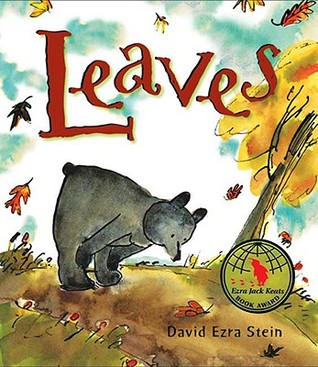
Leaves
Leaves follows the story of a young bear experiencing fall for the first time. The bear had never seen leaves fall off of trees before, so he is immediately distraught and seems to be concerned about what's going on. He tries to place the leaves back onto the trees, but he is unsuccessful and accepts that the season is changing.
As the leaves settle and the wind picks up, the bear gathers leaves and snuggles into a hole to sleep. The bear sleeps through the winter and greets the world and the budding leaves once again in the spring.
I thought that this was a really cute book that subtly introduced the idea of the changing of the seasons and hibernation. Although it was relatively simple, there were some big ideas that the author tackled, especially for young readers.
I think that this is a great teaching tool, especially around fall, when teachers could talk about these topics and integrate science and literacy. Also an interesting way to approach this book may be by introducing a reading comprehension strategy lesson on using the illustrations to understand the bear and its emotions. The illustrations in this book are particularly telling and definitely could help introduce feelings.
Overall, I thought this was a really cute book to use with young readers!
Leaves
By: David Ezra Stein
Published in 2007
By: David Ezra Stein
Published in 2007
Because of an Acorn
Because of an Acorn follows the story of a small acorn and the influence it can have on an entire forest. Through simple words and intricate illustrations, the life-cycle of an acorn is depicted and the interdependence of the natural world is revealed.I think that this book would be a great book to read to students that are in kindergarten through second grade. With simple words and vibrant pictures, students can follow the path of the acorn and see how it influences each part of the natural cycle.
It is also a great book to use with upper elementary students, too. Although the text is relatively simple, there is a lot of back matter included that refers to additional information on white oak trees, the ecosystem, and the food chain. It also explains the function of acorns, sprouts, and saplings and their role in the forest. The most interesting part of the back matter, in my opinion, is the information included about how the forest needs all of its inhabitants and the fact that people cannot survive without forests. This information is paired with resources and tips on how readers can help the environment.
My favorite part of this book were the gorgeous illustrations. The illustrations have this three-dimensional feel to them that make the reader feel as though they are a part of the forest, walking among the trees and animals. The illustrations were made with paint and ink and were scanned to be manipulated digitally. Additionally, there are die-cuts on the first and last pages that are beautifully integrated into the illustrations. These continue to remind readers of the reliance the environment has on the relationships between plants, animals, and humans.
Because of an Acorn
By: Lola M. Schaefer and Adam Schaefer
Illustrated by: Frann Preston-Gannon
Published in 2016
El Deafo
El Deafo is a graphic novel that tells the story of young Cece Bell, a deaf elementary school student adapting to the world around her. She contracted meningitis at the age of four and lost her hearing shortly afterwards. As a kindergartener, Cece attended a school especially for students dealing with hearing loss. Her classmates around her were just like her and she felt comfortable in her environment.
When she moves to a new state with her family, however, Cece begins attending a new school with hearing kids. Although she is excited, Cece is nervous to begin school because she has to wear a giant hearing aid strapped to her chest. She's afraid to be different or stand out from the rest of her class and she is absolutely sure that everyone is staring at her and her Phonic Ear.
Cece initially struggles to make friends, finding people that are too interested in her deafness or inconsiderate of her. She longs for true friendship. Soon enough, Cece discovers that she may have super powers. She can hear everything her teacher is doing, inside and outside of the classroom! Her super powers inspire her imagination and help her think of herself as El Deafo, Listener for All. She hopes that her superpowers will help her to find a sidekick!
I was overwhelmingly in love with this book! I have always been interested in the deaf community and deaf culture and have engaged with members of this community all throughout my life. Becoming fluent in American Sign Language is a goal of mine, but I understand why Cece did not want to get involved with it and recognize that every deaf or hearing-impaired person has their own decisions to make about their involvement in the deaf community.
I think that this book is such an approachable way to broach the topic of hearing impairments and disabilities within the classroom, preaching acceptance and appropriate behavior with others that may be different. It is increasingly important to recognize these differences and celebrate them, as students of all kinds are being included in general education classrooms all over the nation!
These steps towards inclusion make it very important for teachers to include literature within the classroom library that not only educates and celebrates differences that students may have, but also gives students with disabilities the opportunity to see themselves in the books that they read. How powerful this book could be for a student struggling with hearing loss! And how heartwarming would it be to see students better understand that student as a result of a book that they've engaged with!
I would definitely include this, and other graphic novels, in my classroom! I have always been interested in comics and read them throughout high school. These graphic novels give students the opportunity to use all sorts of reading comprehension strategies to come to understand the author's message. I appreciate them and believe they have a place in every classroom!
El Deafo
By: Cece Bell
Illustrated by: David Lasky
Published in 2014
When she moves to a new state with her family, however, Cece begins attending a new school with hearing kids. Although she is excited, Cece is nervous to begin school because she has to wear a giant hearing aid strapped to her chest. She's afraid to be different or stand out from the rest of her class and she is absolutely sure that everyone is staring at her and her Phonic Ear.
Cece initially struggles to make friends, finding people that are too interested in her deafness or inconsiderate of her. She longs for true friendship. Soon enough, Cece discovers that she may have super powers. She can hear everything her teacher is doing, inside and outside of the classroom! Her super powers inspire her imagination and help her think of herself as El Deafo, Listener for All. She hopes that her superpowers will help her to find a sidekick!
I was overwhelmingly in love with this book! I have always been interested in the deaf community and deaf culture and have engaged with members of this community all throughout my life. Becoming fluent in American Sign Language is a goal of mine, but I understand why Cece did not want to get involved with it and recognize that every deaf or hearing-impaired person has their own decisions to make about their involvement in the deaf community.
I think that this book is such an approachable way to broach the topic of hearing impairments and disabilities within the classroom, preaching acceptance and appropriate behavior with others that may be different. It is increasingly important to recognize these differences and celebrate them, as students of all kinds are being included in general education classrooms all over the nation!
These steps towards inclusion make it very important for teachers to include literature within the classroom library that not only educates and celebrates differences that students may have, but also gives students with disabilities the opportunity to see themselves in the books that they read. How powerful this book could be for a student struggling with hearing loss! And how heartwarming would it be to see students better understand that student as a result of a book that they've engaged with!
I would definitely include this, and other graphic novels, in my classroom! I have always been interested in comics and read them throughout high school. These graphic novels give students the opportunity to use all sorts of reading comprehension strategies to come to understand the author's message. I appreciate them and believe they have a place in every classroom!
El Deafo
By: Cece Bell
Illustrated by: David Lasky
Published in 2014
Wednesday, November 2, 2016
Author Study - Landed
Landed is a historical fiction picture book that tells the story of Sun, a twelve-year-old boy that is living in China. Now that he's turned twelve, it is his responsibility to study hard so that he—like his older brothers—can move to the United States to tend to his father's store in San Francisco. Moving to a new country, however, is not an easy task and Sun quickly learns that it takes a lot of effort. He begins studying with a tutor because he will be interviewed and will need to prove that he is not lying about his family and his background.
As a reader, we soon find out that new Chinese immigrants are kept at a place named Angel Island before being admitted to the United States. At Angel Island, officials ask each person specific, detailed questions about their families, their extended families, their homes in China, and their village. These questions are intended to ensure that Sun is actually his father's biological son. Some children were sent as "paper sons"—they were not biologically related to the family that claimed them and they were intending to illegally enter the country to begin a new life in America.
Although Sun is not a "paper son," he is still nervous about the interviews. He is particularly bad at directions (north, south, east, and west). He answers all of the questions confidently, until he is asked a question about the direction of his house. His interview is cut short two other times as a result of his inability to answer the question. Finally, he's surprised with a gift from his father—a compass. It helps him visualize his home and determine the answers to the questions. As a result, Sun is finally released from Angel Island and reunites with his father and brothers!
I enjoyed this book, though I thought that its prose was a little boring and lacked emotion. I could definitely see myself using this in a classroom, however. I think it would work well for upper elementary students that are learning about the immigration process and different cultural groups. It would be interesting to talk to students about their own personal backgrounds, as many United States citizens can trace their roots to another country outside of the United States.
Landed
By: Milly Lee
Illustrated by: Yangsook Choi
As a reader, we soon find out that new Chinese immigrants are kept at a place named Angel Island before being admitted to the United States. At Angel Island, officials ask each person specific, detailed questions about their families, their extended families, their homes in China, and their village. These questions are intended to ensure that Sun is actually his father's biological son. Some children were sent as "paper sons"—they were not biologically related to the family that claimed them and they were intending to illegally enter the country to begin a new life in America.
Although Sun is not a "paper son," he is still nervous about the interviews. He is particularly bad at directions (north, south, east, and west). He answers all of the questions confidently, until he is asked a question about the direction of his house. His interview is cut short two other times as a result of his inability to answer the question. Finally, he's surprised with a gift from his father—a compass. It helps him visualize his home and determine the answers to the questions. As a result, Sun is finally released from Angel Island and reunites with his father and brothers!
I enjoyed this book, though I thought that its prose was a little boring and lacked emotion. I could definitely see myself using this in a classroom, however. I think it would work well for upper elementary students that are learning about the immigration process and different cultural groups. It would be interesting to talk to students about their own personal backgrounds, as many United States citizens can trace their roots to another country outside of the United States.
Landed
By: Milly Lee
Illustrated by: Yangsook Choi
Published in 2006
Tuesday, November 1, 2016
Author Study - Behind the Mask
Behind the Mask is a picture book that blends Korean and American traditions to make an interesting and engaging story. A Korean boy, Kimin, has nothing to wear for Halloween. To inspire him, Kimin's mother leaves a few of his grandfather's keepsakes in his room. They are family treasures and she warns him to guard them carefully.
Although Kimin is apprehensive because the memories he has of his grandfather aren't pleasant, the young boy looks through the boxes. He becomes more and more curious the more he discovers. Eventually, Kimin finds his grandfather's dancing costumes and masks and he knows what he wants to be for Halloween! He sneaks away to trick-or-treat before his mother can catch him wearing the family treasures.
After a night of dancing, candy, and friends, Kimin returns with a damaged mask. He took a tumble and scratched the front. After racing home to tell his mother, he's surprised by all of his friends that have followed him home to return a note that fell from the mask in the accident. The letter was from Kimin's grandfather and he proudly left all of his masks to Kimin after his death. Kimin was so excited and showed off all of his grandfather's items to his friends. His mother also helped him hang up the masks in his room. As a result, he came to appreciate his culture and his grandfather's role in his life.
I enjoyed reading this book by Yangsook Choi and am beginning to notice a pattern with the themes of her books. Often times they are about accepting one's own culture or background, and this is something that Kimin is directly confronted with. Although he is afraid to be himself at first, he is celebrated for it by his friends at the end of the book.
Another aspect of Yangsook Choi's writing is that she continually uses foreign languages throughout the text. For example, "tal" means mask, which the author uses quite often throughout the text. Incorporating these aspects of the Korean culture made the book more interesting and diverse. It also worked to celebrate the character's curiosity and their willingness to learn about their own background.
Yangsook Choi is an illustrator, too, and illustrates her own books. Behind the Mask is a great example of her work because she consistently makes an effort to make her books relatable to several kinds of readers. Each illustrations represented multiple cultures and features several kinds of trick-or-treaters.
Within the illustrations, multiple cultures of "trick or treaters" are represented.
I would definitely use this book in my classroom during Halloween to celebrate the different cultures that have similar kinds of celebrations around the world.
Behind the Mask
By: Yangsook Choi
Published in 2006
Although Kimin is apprehensive because the memories he has of his grandfather aren't pleasant, the young boy looks through the boxes. He becomes more and more curious the more he discovers. Eventually, Kimin finds his grandfather's dancing costumes and masks and he knows what he wants to be for Halloween! He sneaks away to trick-or-treat before his mother can catch him wearing the family treasures.
After a night of dancing, candy, and friends, Kimin returns with a damaged mask. He took a tumble and scratched the front. After racing home to tell his mother, he's surprised by all of his friends that have followed him home to return a note that fell from the mask in the accident. The letter was from Kimin's grandfather and he proudly left all of his masks to Kimin after his death. Kimin was so excited and showed off all of his grandfather's items to his friends. His mother also helped him hang up the masks in his room. As a result, he came to appreciate his culture and his grandfather's role in his life.
I enjoyed reading this book by Yangsook Choi and am beginning to notice a pattern with the themes of her books. Often times they are about accepting one's own culture or background, and this is something that Kimin is directly confronted with. Although he is afraid to be himself at first, he is celebrated for it by his friends at the end of the book.
Another aspect of Yangsook Choi's writing is that she continually uses foreign languages throughout the text. For example, "tal" means mask, which the author uses quite often throughout the text. Incorporating these aspects of the Korean culture made the book more interesting and diverse. It also worked to celebrate the character's curiosity and their willingness to learn about their own background.
Yangsook Choi is an illustrator, too, and illustrates her own books. Behind the Mask is a great example of her work because she consistently makes an effort to make her books relatable to several kinds of readers. Each illustrations represented multiple cultures and features several kinds of trick-or-treaters.
Within the illustrations, multiple cultures of "trick or treaters" are represented.
I would definitely use this book in my classroom during Halloween to celebrate the different cultures that have similar kinds of celebrations around the world.
Behind the Mask
By: Yangsook Choi
Published in 2006
Subscribe to:
Posts (Atom)